By the end of the day, our main aim is to answer the following question. Was it favourable circumstances or Hitler’s leadership abilities that led to his rise in prominence in the late 1920s? Follow through our journey as we find out more!
*WARNING: BRING ALONG A BOTTLE OF WATER AS THERE WILL BE A LOT OF THINGS TO READ! Done? Sit back and relax. :)*
HITLER
Cult of the supreme leader (additional information)
§ The leader which is called the Fuehrer is known as a precise person meaning that Hitler is incapable of making mistakes or being wrong.
§ He is much more extreme cult compared to the other Italian leaders.
§ He also established a necessary salute which is called the “Heil Hitler”


WEAKNESSES OF THE WEIMAR GOVERNMENT
- A majority of people preferred voting for a party instead of choosing a specific candidate
- Democratic and fair system but ended up in the state of breaking into fragments
- Each party was then given an allocated seat in the Reichstag through the number of people who voted for it. It was a disaster as there were a lot of tiny parties. No party was strong enough to get a majority seat and therefore, there were no government managed to get its laws passed in the Reichstag. This was a major weakness of the Republic.
- There are just way too many competing parties that did not have a majority
Article48 of Weimar CONSTITUTION:
It allowed the president to take emergency measures without the concern of the Reichstag. In the case of emergency, the president did not need the agreement of the Reichstag but instead, they could issue decrees for six months in time of emergency but it did not say specifically about what was an emergency about and Hitler used this to take power legally and remain in power.
Coalition Government:
Coalition government is a parliament where a few political parties work together to reduce the dominance of a party within the coalition. The reason for this arrangement is that no party can achieve a majority in the parliament on its own. A few parties had extreme ideas but were not willing to compromise and the coalition government kept on breaking up which results in frequent changes of the government. There were 20 different coalition governments between the year 1919 to 1933. Due to this, it was difficult to pass down the law. Hence, it was seen as inadequate to the Germans.
Weak Support:
Weimar government had lacked of support from the people, politicians and soldiers too. The right-wing attempted to overthrow the government in 1920. The judiciary, civil service and also the big businesses were mostly under the influence of advisors that had worked for the Kaiser and were loyal that wished for his return. Thus, it was difficult for the Weimar government to gain the support and loyalty. This makes them to appear weak and had difficulties to hold on to power and authority.
The opposition of the left-wing and right-wing:
Left-wing: they were influenced by the Russian Bolsheviks and are also known as the communist. They wanted equality in the society .They opposed the idea of democracy. They believed in the idea of collective goods and not personal goods. The Communist Workers’ council took control of most part of Germany while the People’s Government took control over Bavaria. But in 1920, the freikorps, the soldiers and also the police destroyed the Red Army rebellion in the Ruhr.
Right-wing: They consist of supporters of the German Kaiser who are interested in the old system and they are the members of the military. They disagreed with the Treaty of Versailles(TOV) as Germany were expected to pay a huge amount of reparation which consist of 269 billion of gold Reichmarks or 96.41 million kilograms worth of gold. Germany was not allowed to have strong air force and naval base such as submarines and tanks. They wanted a dictatorial style of government. The right-wing did not accept Germany’s defeat in the war but instead blamed the politicians for not having the courage to continue with the war.


HYPERINFLATION
BACKGROUND
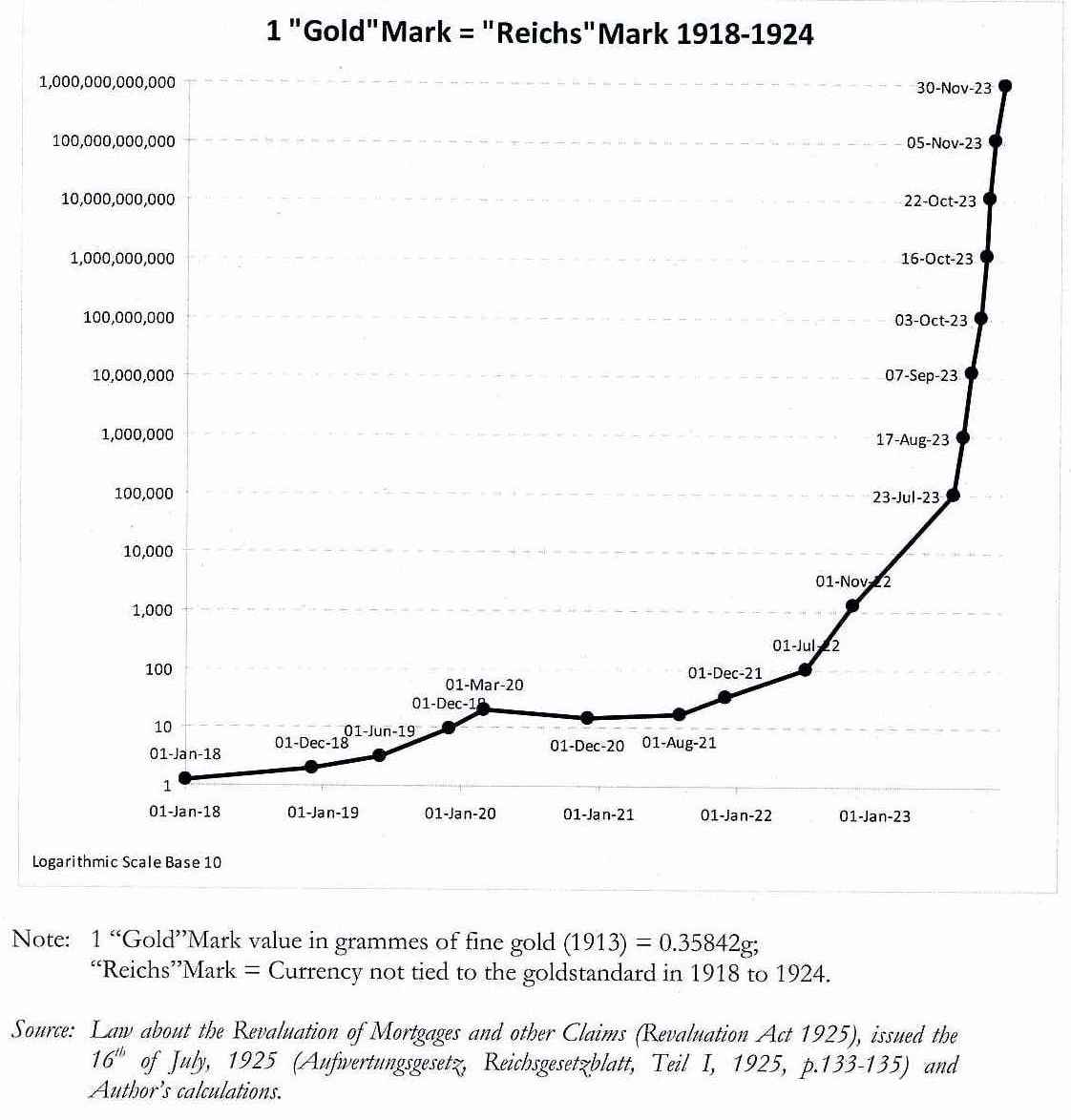
The hyperinflation in the Weimar Republic in Germany was a three-year period between June 1921 and January 1924. In order to pay the large costs of World War 1,Germany suspended the convertibility of its currency into gold when that war broke out.The first payment was made when due in June 1921. By November 1921, the Mark fell to less than one third of a cent (approx. 330 Marks per US Dollar). Due to reparations being required to be repaid in hard currency,one strategy that the Germany employed was the mass printing of bank notes to buy foreign currency which was in turn used to pay reparations. This greatly make it worse on the inflation rates of the paper mark.
HYPERINFLATION
In the beginning of August 21, Germany began to purchase foreign currency with Marks at any amount of price, but that only increased the speed at which the Mark decreases in terms of value. The lower the Mark sank on foreign exchanges, the more marks were needed to buy the foreign currency that were demanded by the reparations commission.
During the first half of 1922, the Mark stabilized at about 320 Marks per Dollar.This requires a lot of work to be done.
When these meetings produced no feasible solution, the inflation changed to hyperinflation and the Mark fell to 800 Marks per Dollar by December 1922.
In January 1923 French and Belgian troops occupied the Ruhr, the industrial region of Germany. It is to ensure that the reparations were paid in goods, such as coal from the Ruhr and other industrial zones of Germany. Because the Mark was practically worthless, it became impossible for Germany to buy foreign exchange or gold using paper Marks. Instead, in order for them to pay reparations, they paid using goods.Then the workers in the Ruhr started on a strike, and the German government printed more money in order to continue paying them.
By November 1923, the American dollar was worth 4,210,500,000,000 German marks. As a result of hyperinflation, there were news accounts of individuals in Germany suffering from a compulsion called "zero stroke", a condition where the person has a desire to write endless rows of the number zero. Whether or not there area lot of zeros or not, the money actually had no value.
The impact of hyperinflation:
- People were being rushed to pass money to loved ones so that it could be used before it became worthless
- Those who were poor became even poorer and in the winter on 1923, they burned furniture to be warm and get some heat. That's the only resolution for them to survive in the cold. Can you imagine you yourself do not have any heat appliances? You are willing to do anything that you can in order to gain some heat. This is what they experienced.
- The middle class is the next one who suffered a lot. Their hard earned savings disappeared within a night. They did not have the wealth or land. Many middle class families had to sell family heirlooms to survive.
- The very rich suffered the least because they had sufficient contacts to get food and etc. Most of the very rich were land owners and they could produce food on their own without the need to ask for help.
The Great Depression
BACKGROUND INFORMATION:
- The Great Depression. It was a serious worldwide economic depression in the decade that comes before World War 2. The timing of the Great Depression depends across nations, However in most countries, it started in the 1930s and lasted until the late 1930s or middle 1940s. It was utterly the longest, serious and the most sorrowful depression of the 20th century
- Particularly, those countries that really depend on heavy industries were hit hard. Also, cities from all around the world too, were hit hard. Due to insufficient money, construction had to halt at the moment in the majority countries. The ones that suffered the most were those areas that dependent on primary sector industries for example, cash cropping, mining and logging.
- Here is the definition of cash cropping: A cash crop is an agricultural crop which is grown for sale to return a profit. It is typically purchased by parties separate from a farm. The term cash crop is applied exclusively to the agricultural production of plants; animal agriculture is not a part of the terminology.
- In the 21st century, the Great Depression is commonly used as an example of how far the world's economy can decline.The depression originated in the U.S., after the fall in stock prices that began around September 4, 1929, and became worldwide news with the stock market crash of October 29, 1929 (known as Black Tuesday).
- Deliver a strong government
- Revive Germany's former glory
- Overturn the Treaty of Versailles and restore Germany's former borders
- Bring (more) German speakers into the Reich
- Expand into Russia and Poland to create Lebensraum or 'living space'for Germany in the east
- Embark on territorial expansion to gain land and resources, to achieve the greatness that German people were destined for
- Capitalist economic policy
- Included talk of equality, state control of economy and creation of jobs, which attracted the Left
- Anti-Bolshevik and anti-communist views appealed to the Right
- Promise to solve Germany's two main problems of rampant unemployment and crisis in the farming sector
- Had vogue policy statements allowing them to change their policies when it was advantageous to do so
- Appeared to offer something for everyone
- Used modern and effective campaign methods to get their messages across


FOR MORE INTERESTING FACTS CLICK HERE!!!!! *highly recommended* http://www.thegreatdepressioncauses.com/effects-of-the-great-depression-facts.html
NAZI IDEOLOGY
Hitler utterly opposed socialist ideas especially those that involves racial or sexual equality. He believed that Jews and Marxists lost the World War 1 for Germany. Since socialism was quite well known in Germany particularly after the World War 1, he renamed his party to National Socialist German Workers Party (NSDAP) to tell the people that he preferred equality for those who had German’s blood in their body.
In 1923, Hitler was imprisoned after the failure of the MUNICH PUTSCH. His party and he himself tried to bring down the Weimar government but he lost.
While he was in jail, he created a book called “Mein Kamphf”, the Bible of Nazism which outlined Nazi goals and ideologies. He collaborate his written book with his lieutenant Rudolf Hess and dictated it to his chauffeur, Emile Maurice. He used the chance to publicize about the Nazis and his popularity. Due to this, almost the entire nation knew who is and what his stand is. Mein Kamphf was very popular due to his promises and ideology, that it sold for about 5 million copies and this made him very
wealthy.
In February 1920, the NSDAP released their 25 point programme. The following are his main point in this programme: ADAPTED FROM HISTORY TEXTBOOK
- The abolition of the Treaty of Versailles
- The union of Germany and Austria
- Allowing only ‘true’ Germans to live in Germany (Jews in particular were excluded)
- Nationalisation of large businesses
- Increases in old age pensions
| This is the "MEIN KAMPHF",the bible of Nazism. |
- Establishment of a strong central government
THE NSDAP were seen to be the sole of the right wing party that could fight against the left wing party. The central role in anti-Semitism played in Nazism was the main difference between Nazi and Italian fascist beliefs. Hitler and the National Socialists believed in the superiority of the white Aryan or Germanic races.
Hitler's promises
*disclaimer: I copied the Hitler's promises and Nazi ideology and policies directly from history textbook. If i were to rephrase it, I'm afraid that it will change the meaning of the sentence and it can cause a misconception or misunderstanding*
CHARISMA AND ORATORICAL SKILLS + SKILLFULNESS AT MAKING DEALS WITH POLITICIANS
Hitler's charisma was also a major factor as to why he had a great number of German reinforcement. He was an impactful orator with a strong conviction of himself.He swore by that his purpose was to rule not only Germany, but the world.
In order to persuade the follower that he needed, Hitler would prepare and practise his speeches. He was ace at gauging the mood of the audience.He had unbelievable energy; letting him do up to 4 speeches in a day. From the people's perspective, he seemed to be sincere. He was a true orator.
Hitler would make many speeches in beer halls where people were calm and easily vacillated by his words. He would start his speeches slowly and reasonably. However, he would bluster and jabber when the audience get sloshed. Example of speech below.
In addition, Hitler knowing the people's concerns convinced them even more.
He used 'November Criminals' communists and the Jews as scapegoats for Germany's ills.
Exploitation of the fears of Communism
- How did Hitler exploited fear of Communism to win Support from the people?
- Hitler used pictures and posters to spread fear about the aims of the Communists. He said that the communists were only interested in confusion and chaos and forcible overthrow of the government or social order in favour of a new system. The communist would remove the rich property such as lands to the workers. Hitler also emphasis that the Nazi Party was the only political party that could provide order and preventing communists from setting up a communist dictatorship like Russia. In order to maintain the country as the anti-communist government, many rich gave financial support to the Nazis so that they would have the power to prevent the communist to take over.
-Why did the people support Hitler?
- When the Weimar Republic appeared to have no idea how to solve the problems of the Depression, the Nazis promised the people that they will solve the problems. Hitler promised many groups in Germany what they wanted. He make used of the Jews and other sections of society as scapegoats, blaming and accusing them on all the problems that they have faced. Hitler united everyone by providing explanations for Germany’s problems. Many people in Germany were tired of their poor quality of life, which made Hitler making another promise to the Germans, he pledged something for every part of Germany society.
- To the Farmers – Higher prices for their produce > making up for all their losses during the Depression.
- To the Unemployed Workers – Jobs building public works such as roads and stadiums.
- To the Middle Class – To restore the profits of small business and the value of savings. To end the Communist threat. Hitler’s leadership abilities
- His 25-Point Program was on
o The Removal the Treaty of Versailles.
o The Union of Germany and Austria
o Nationalisation of large businesses (under government control)
o Increase in old age pensions
o Setting a strong central government
o Allowing only true Germans to live in Germany thus excluding non-true Germans such as the Jews and Gypsies
- Hitler was a powerful speaker who was very convincing and had great charisma. He has the knowledge on how to gauge he mood of the audience and had incredible energy. He was able to sway the audience to see his point of view.
- He was a/an
o Excellent speaker and a Charismatic leader
o Has the power to reorganize the Nazi Party
o Exploited the fear of Communism to win support
o Skillful at making deals with politicians
Reorganisation of the Nazi Party
Hitler learned from his mistakes while he is imprison a few days before Christmas in 1924. He was released from the prison after 9 months. During the days when he was in prison, he wrote a book named Mein Kampf , giving thoughts about the failed Nazi revolution during November 1923 and its future. This shall be more elaborated on the part Nazi Ideology.
He realized that his actions of wanting to overthrow the democratic government was being made to early, as he does not have the support from the German Army and other established institutions. He made a firm decision of avoiding making the same mistakes again. No matter how much the Nazi Party members wants to take action against the young German democratic republic, it is impossible for them, even with such situation, Hitler choose to not give in to them like the past in November 1923.
Hitler had a new idea on how to overthrow the government and take over Germany for him and the Nazis, by playing along with the democratic rules and getting elected.
Summary
- Hitler reorganised the Party to make it more efficient and ensure that it was prepared.
- Mein Kampf , being the best seller book.
- Nazi Party rally was held at Weimar during 1926 and it began the pattern of military–styled parades.
- The SA ( stormtroopers ) was strengthened and more young men were encouraged to join. The focus was discipline rather than violence and intimidation.
- Joseph Goebbels organised Party Propaganda and used it effectively.
- The Nazis focused on winning support in agricultural areas from 1928 onwards due to the depression that affected farming during the 1920s and worsened during 1927 with a fall in food price.
- Bamberg Conference – George Strasser and Joseph Goebbels wanted to make the Party more socialistic to appeal to the working classes. Hitler objects to the idea and called for a Party conference in Bamberg ( Bavaria ) in 1962. His leadership was confirmed with Goebbels being one of his closest supporters.
- To appeal to a particular demographics. The Nazi Students’ League , Teachers’ League , and the Women’s League were set up. There was also the Nazi youth movement to appeal the young.


Now to answer the first rhetorical question at the beginning, whether it was favourable circumstances or Hitler’s leadership abilities that led to his rise in prominence in the late 1920s? We believe that both of the favourable circumstances and Hitler's leadership abilities that led to his rise in prominence in the late 1920s. Without Hitler's ideas or suggestions, i don't think that the favourable circumstances will come in handy. Neither will be Hitler's leadership abilities. Even if the favourable circumstances allowed him to rise in power, but without his clever brain nothing will be able to go with his way.
Thank you for spending your time reading our blog! Hope you gained some knowledge about Hitler! Have a nice day ahead! :D
DONE BY: NADHIRAH, THAHIRAH, AISHA, HIDAYAH, SHAY and ZIFANG 3B!
